
Cover

Photo: StockSnap (CC0)
Spotlight
PAGE: https://alison.com/course/achieving-work-life-balance
PROMISE: Stop work from bleeding into personal time with practical boundary tools.
WHO: Remote workers or home-based professionals who feel work and personal life are blurring.
WHYNOW: The cost of ignoring the blur grows every day as stress and resentment build.
DESC: Master work-life balance with practical strategies for achieving personal and professional equilibrium.
BEFORE: Work tasks spill into personal time because there is no clear end to the day.
BEFORE: The home workspace feels like a permanent office, so the mind is always on work.
BEFORE: Personal needs are postponed because they are not treated as important as work tasks.
AFTER: Work tasks stop at a set time because the daily structure is explicit.
AFTER: The mind separates work and personal modes through planned transitions.
AFTER: Personal needs are scheduled with the same priority as work deadlines.
GAIN: A clear set of rules that stop work from invading personal time.
GAIN: A weekly plan that treats personal time as fixed, not optional.
GAIN: Practical techniques to switch modes without needing a separate physical office.
STEP: Work emails appear in the family group chat at dinner time. || Identify the strategies to establish effective boundaries || Set clear rules for when work communication is acceptable and when it is off the table.
STEP: The workday has no end, so personal time gets eaten by tasks. || Outline various effective time management techniques || Use a structured schedule to lock in work hours and protect personal time blocks.
STEP: The home office becomes the office, so work always feels present. || List the various strategies for integrating work and personal life || Create rituals that separate work mode from personal mode within the same space.
STEP: Burnout hits because self care is always the last task on the list. || State the process of planning and scheduling work and personal activities for optimal balance || Treat rest and personal time as fixed appointments in the weekly plan.
NOTFOR: Anyone who needs a physical, dedicated office space to function.
NOTFOR: Those looking for a detailed, room-by-room home office design guide.
FACT: Average duration: 1.5-3 Hours (Contains Video)
FACT: CPD-accredited certificate available
FACT: Beginner level
COVERS: Discuss the impact of stress and its management on work-life balance
COVERS: Indicate the personal and professional responsibilities effectively
COVERS: Outline various effective time management techniques
COVERS: Identify the strategies to establish effective boundaries
COVERS: State the process of planning and scheduling work and personal activities for optimal balance
COVERS: Identify the mindfulness and relaxation techniques for stress reduction
COVERS: List the various strategies for integrating work and personal life
COVERS: Recognize the ways to create personalized plans to achieve and maintain personal-professional harmony
COVERS: Summarize the importance of prioritizing self-care practices for sustainable balance
COVERS: Explain the methods for delegating tasks and responsibilities effectively
COVERS: Discuss the strategies and tools for achieving sustainable work-life symmetry
COVERS: Define the essential principles and components of work-life balance
MODULE: Mastering Work-Life Harmony || Strategies, Challenges, and Time Management for Life Balance | Mindful Decisions for Personal Development and Career Success | Managing Distractions to Enhance your Work and Lifestyle | Deep Work: Unlocking Productivity and Creativity
What you are probably seeing
Notice that your productive hours drop sharply when household noise or chores interrupt your schedule. The workday stretches out because you never have a physical trigger to stop.
Observe that you end work at 5 PM mentally but keep answering emails in the living room after dinner. The blur between zones makes it hard to be present with family.
Why it happens
Your brain associates specific locations with specific modes. Mixing professional tasks with domestic chores in the same room creates cognitive friction and reduces focus.
A home setup often lacks a clear finish line. Without the ritual of commuting or locking a door, the work and personal lives remain entangled.
What changed recently
Step by step
1. Track all times in the last three days when a household interruption stopped your focused work. Note whether you immediately returned to the task or drifted away.
2. Identify the specific trigger that makes you start working and the trigger that makes you stop. Confirm if those triggers are physical or arbitrary.
3. Set a hard time limit for when work ends at home and block that time on your calendar as a non-negotiable meeting with yourself.
4. Test a single work session at a dedicated location like a local library or co-working space for one hour to see if focus improves.
5. Compare your output and stress levels from the dedicated session against your typical home session to decide which environment is more effective.
Ways to go further
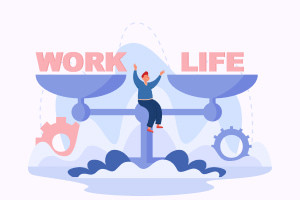 Start here: Achieving Work-Life Balance For when you need general frameworks to stop work from spilling into personal time. Open the free course on Alison ↗
Affiliate links: CHEAPUNO may earn a commission if you buy through them, at no extra cost to you.
Other problems readers raise
How to compare eSIM data caps to remote work usage
Does Akariq 3-click eSIM work for Europe without an app?
How to verify eSIM multi-operator support for global regions?